
What Does It Take to Add EEG + ERP Acquisition to Your Practice?
A practical look at equipment, staff, space, training, and workflow.
EEG has traditionally been associated with specialized labs, dedicated technicians, and complicated setup.
For many outpatient practices, that can make adding EEG and event-related potential (ERP) acquisition seem impractical.
But the real question is simpler:
What does a practice actually need to add EEG + ERP acquisition to its workflow?
The answer comes down to five things: equipment, space, staff, training, and a clear process for handling the data.
1. What equipment do you need?
A clinical EEG + ERP setup typically includes:
- Electrodes or a headset
- EEG acquisition hardware
- A computer or tablet with acquisition software
- Stimulus equipment, such as headphones, for ERP protocols
- Consumables
- A system for storing and reviewing data
The exact setup varies by system, but practices should look beyond the initial equipment cost and consider ongoing supplies, setup time, and ease of use.
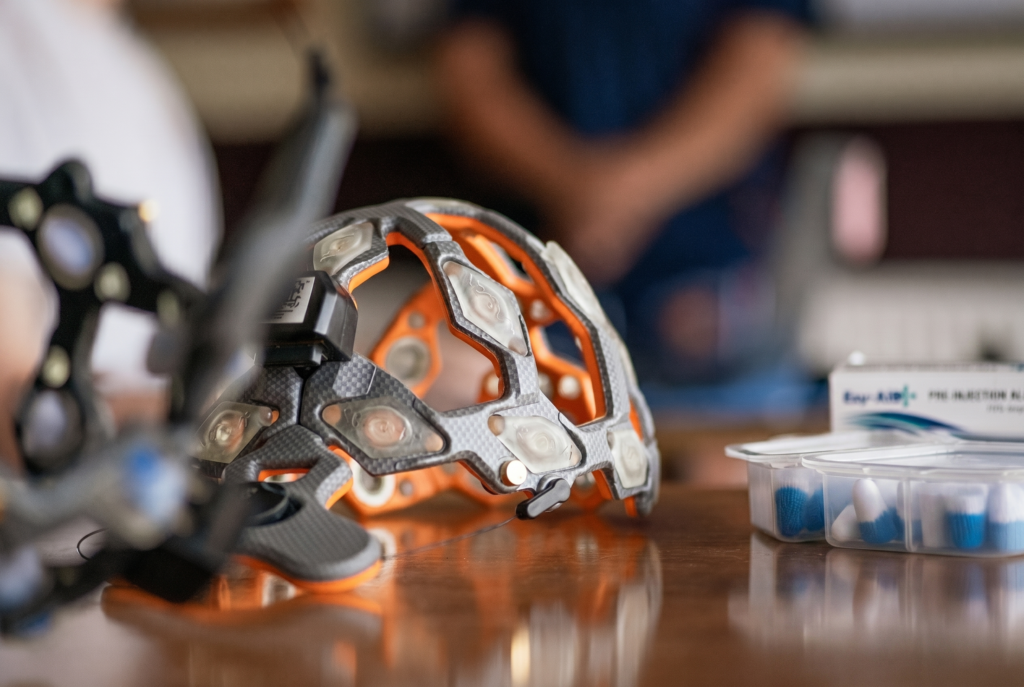
2. How much space does it require?
Not every EEG workflow requires a dedicated laboratory.
Depending on the system, acquisition may be performed in a standard exam room with:
- A stable patient chair
- A small workstation
- A computer or tablet
- A relatively quiet environment
The key is consistency. The room should allow staff to prepare the patient, check signal quality, run the selected protocols, and minimize unnecessary interruptions.
3. Do you need an EEG technician?
Not necessarily, depending on the system and workflow.
It is important, however, to separate data acquisition from clinical interpretation.
Staff performing acquisition may be trained to handle:
- Patient preparation
- Electrode or headset placement
- Signal and contact checks
- Running standardized protocols
- Basic troubleshooting
- Saving and managing recordings
Clinical review and interpretation remain separate responsibilities.
For many practices, the more important question is not whether they have a dedicated EEG technician, but whether appropriate staff can be trained to perform the acquisition process consistently.

4. What does the workflow look like?
A practical EEG + ERP workflow usually follows a simple sequence:
Prepare → Fit → Check Signal → Acquire → Review → Store
The total time depends on the system, number of protocols, electrode contact, and patient preparation.
When comparing systems, practices should evaluate the entire workflow, not just the recording time.
A system that is technically capable but difficult for staff to use consistently may never become part of routine clinical practice.
5. What happens to the data?
Practices should know how EEG and ERP recordings will be displayed, stored, reviewed, and documented.
Questions to ask include:
- Where is the data stored?
- Can previous sessions be reviewed?
- Can recordings be compared over time?
- Are reports available?
- Can data be exported if needed?
- Who is responsible for clinical review?
The WAVi Scan EEG System is FDA-cleared for the acquisition, display, and storage of EEG and event-related potential data to aid in diagnosis.
A Practical EEG + ERP Workflow with WAVi
WAVi combines the major parts of EEG + ERP acquisition into one structured workflow.
The system includes a standardized headset, acquisition hardware, software, defined protocols, training, and ongoing support.
WAVi staff training focuses on the practical steps required to operate the system, including:
- Patient preparation
- Headset placement
- Signal quality
- Protocol administration
- Troubleshooting
- Data handling
The goal is to make standardized EEG + ERP acquisition practical within an appropriate clinical setting.
Before Adding EEG + ERP to Your Practice
Before choosing a system, ask:
- Who will perform the scans?
- Who will review the data?
- Where will acquisition take place?
- How long will each session take?
- What training is required?
- What consumables are needed?
- How will data be stored and documented?
- What ongoing support is available?
These practical questions are often just as important as hardware specifications.
See How EEG + ERP Acquisition Fits Into Your Practice
See the WAVi workflow from patient preparation through acquisition, review, and storage.
Related Reading
For healthcare professionals only. WAVi is intended for use by qualified healthcare providers as an aid in diagnosis.